I haven't updated my blog recently and, while I didn't think of this as a problem, I've been alerted to several messages of disappointment, displeasure, anger, death threats, etc. due to the lack of updates. While the masses clamor for more about the fascinating, exciting, groundbreaking work I do and rockstar-esk social life I maintain I can't say no. And, as shocked as I was to discover I had any readers at all, much less that some persist after 6 months, this post should take care of any that remain.
I've got to give a talk tomorrow in Tirana at a conference of women's social services organizations on the European Commission's grant programs. I didn't know anything about the EU's grant system when they asked me to do so, mind you, but, as I love the sound of my own voice, I agreed to the presentation. I've got about 45 minutes for a short slide show and then questions on the topic I've selected which is the European Union's Instrument for Pre-accession Assistance (IPA) Multi-annual Indicative Planning Document, Albania Annex. I must warn you, if you had already planned to read this document, stop now; spoilers follow.
The EU's outline of the Instrument for Pre-accession Assistance is based on an evaluation of the success and challenges of the previous Poland and Hungary: Assistance for Restructuring their Economies (PHARE) and Community Assistance for Reconstruction, Development and Stabilization (CARDS; primarily directed at Western Balkans) programs. Both programs promoted social, economic and political development while laying groundwork needed for eventual EU membership. While IPA builds on the strengths of projects implemented under past programs the objectives of IPA, the IPA program encompasses objectives that are a marked departure from previous initiatives (specifically, emphasizing EU Ascension readiness benchmarks) and Albania, in particular, is something of a special case itself within IPA. There is also a reduction of funding from the previous CARDS cycle.
The Albania IPA program is planned to run from 2007-2013 and 5.746 billion Euros have been budgeted for the 2007-2009 period. While the majority of the budget of the general IPA program is dedicated to Social-Economic programs (42-50% according to the Multi-annual Indicative Planning Document), Albania's IPA is largely focused on compliance with European Union standards and "align with the acquis in internal market, sectoral policy and justice,
freedom and security fields" (50-60% of the budget for the same time period). There are a number of reasons for the tangent from general IPA funding priorities but the main purpose here is to discuss IPA program implications, not its genesis. Also, because the social services community is, naturally, only concerned with the provisions that affect their sectors, only about 25-30% of the allocations that are directed towards Social-Economic programs are relevant here. Among those allocations includes budgeting for improvement of business climate, the reduction of unemployment, a better linkage between (preferably higher) education systems and private sector employment opportunities, and the strengthening of social welfare services (with an emphasis on vulnerable groups including domestic violence victims and the Roma community).
The conference talk will focus on the "Institution and capacity building for bodies offering social services (both at central and local level)" sub-program. While there is a provision for improvement of educational opportunities ("The institutional set-up of universities will be strengthened, the academic information network will be established and new modular curricular will be developed.") and most social services agencies that deal with women and girls at risk for social issues have a relationship with a school or schools, the focus of the attendees is not academic so will not necessarily qualify for much of the funding under that program. The Document does not specify individual grants that will qualify for social services capacity building but it is important to be aware of the sub-program's existence and expected result so an organization can be watchful for calls for proposals and craft those applications with the IPA's general goals in mind. Submitting a proposal for a project that achieves several of the IPA objectives demonstrates a more mature organization operating at a higher level of services and signals to the donor that the preparer has both researched the grant's focus and is committed to executing it.
In addition to program and sub-program specifics, the Albanian Annex of the Multi-annual Indicative Planning Document also offers several (is anyone still reading this?) hints of possible best practices for grant applications. As always, the language used in the outlining of the document's goals and objectives in Albania is useful as a guideline when constructing the text of the application (being careful to imitate style and cover all relevant points without simple duplication). In addition, supporting documentation like the Planning Document is useful in anticipating possible flags that could be accidentally written into applications. For example, many European Commission grants specifically prohibit operating costs as eligible expenses but do not specify the maximum administrative costs (as a percentages of the total) that the grant can claim. The prohibition on operating costs should signal to the alert grant writer that he/she should be sensitive to administrative costs when constructing the budget. In the developing world administration percentages can often run 30-50% of a grant's budget (few or no organizations independently fund raise so are dependent on projects to pay all costs) this is certainly no small consideration.
If there's one critical observation that should be taken away from an examination of the Document though, it should be the marked decrease in funding for development programs in general and social services in particularly. I try to impress the importance of the worsening aid situation upon all my clients and rarely is it as conspicuously demonstrated as in the Albania IPA. Funding for the area has been reduced from 330 million Euros under the CARDS initiative to just under 213 million in IPA; 50% of which is aided towards accession standards. While waning international support is tangential to IPA's direct implications it's an important topic to bring up whenever possible. It would be better for organizations to begin to cultivate donor bases now rather than in 10 years when aid has largely departed Albania.
Hopefully that will take up 45 minutes. There aren't a lot of specific tips I can give for winning the next round of IPA grants but hopefully my audience tomorrow will take away some information about the larger goals of the funding and be conscious of them when constructing their applications. And, as I would bet, few non-profit professionals in Albania will read the IPA goals anyway (maybe just me? hopefully not?) it will be good that the audience take away some considerations that may not have occurred to them otherwise. Perhaps one of them will even look for the supplemental literature to a grant program next time they're looking for funding. It's a difficult thing to convince people to do but so very critical. I was submitting a grant to the Dutch Embassy in Tirana a few months ago for a client and we were down to the final touches before I discovered, buried on a website, that they "strongly recommended" duplexing grant applications to save trees. A little research goes a long way in catching those little things that can make a big difference and, by printing double sided sheets for that grant, maybe that little extra research will convince my client to save paper with all their documents?
But that's a whole 'nother conference.
Tuesday, February 10, 2009

Sunday, November 23, 2008
United Nations Development Programme
I won my first grant in Albania on Monday! The Association for Women with Social Problems (AWSP) won an award from the United Nations Development Programme (UNDP) for an anti-domestic violence campaign this week and I'm psyched to have worked on it. I was a little surprised about the timing, we had only submitted the grant the Monday before and that meant turn around of less than a week. I'm not sure if that's the norm or an exception in this case though.
I'm especially pleased at the turnout because the project started off with some bumps. I didn't get told about the grant competition until Thursday afternoon on Nov. 6 and proposals were due Monday morning, Nov. 10 which left me with about 1 business day to write this.
Ok, fine...deep breath...
Fortunately they had started on it (sort of) and at least had a clear idea of what they wanted to do (mostly). My counterpart Aureola gave me her first draft which made me a little uneasy. All of the staff at AWSP are program people (social workers, psychiatrists, etc.) so their development work lacks a certain polish. UNDP had included a rubric with their RFP and a quick check against AWSP's proposal found that a lot of the requested information were missing. The planned project itself was pretty good but it hadn't been entirely thought out to its completion and none of the supplemental information that usually goes with a grant proposal was ready.
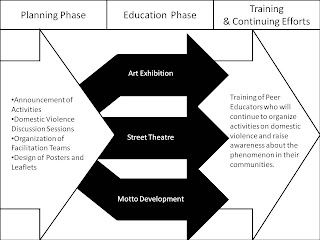
The project itself is pretty well designed: it's an awareness campaign aimed at reducing domestic violence in low income areas by targeting high school students. Most of the campaign was pretty standard stuff (discussion groups, posters, training peer-to-peer educators) but there were some very innovative components too. AWSP was organizing an art exhibition depicting students' perceptions of domestic violence to be displayed in participating schools and a street theater piece doing much the same thing. For the theater piece the organization is copying a model actually developed by a Serbian NGO in Belgrade that forces people to visualize the violence and its consequences. They showed me a DVD of the performances from the Belgrade campaign and it's pretty impactful stuff, I was impressed.
I had gotten to the office around 2 on Thursday (I work with Civil Society Development Center on Thursdays and Fridays) and ended up leaving around 7 after working with Aureola and other staff to fill in the (many) blanks on their proposal. I finally left when they closed up shop but not before making them swear on their mothers' graves that they would get me the outstanding information I still required by the next day. I mocked up the visual over dinner that night, which, I really think is one of the most important parts of any proposal. Probably the most important thing I learned at Alford is: if you can represent it visually, you should. It's really true, how much of your work do people generally read? Especially if they have it all laid out in a single powerpoint slide? Unfortunately working in the developing world means limited access to color printers so I had to work in black and white.
We got the technicals and supplementals done on Friday by COB but I ended up coming in on Saturday anyway to look over the financials and oversee production. Hopefully that won't become a habit here but I had enough crunch times in the U.S. to know that I should expect them here too. The one ambiguous point about working through Peace Corps that I can't decide whether I like or not is that I don't have to really account for my time at the end of the week. It's great in a lot of ways because I can do a 48 hour push like this without a) having to worry about getting overtime approved and b) being able to spend as much time on something as I think it needs without someone demanding why the project is taking so long. I remember doing 9 drafts of a project outline at Alford until my boss was happy and then his boss coming to me and telling me to justify the long development period. Sigh.
The downside of being detached from the traditional work schedule is that, now, if something needs to get done, it needs to get done and it doesn't matter if work hours are over or not. When I left my cubicle at 5 in the U.S. I was done working because I was encouraged not to work on projects after hours. After all, they'd have to pay me more then. But here spending nights and weekends in front of RFP's will probably be, if not regular, at least not unusual.
I prefer being busy to the alternative though. After a month of doing nothing in Armenia waiting out the war I'm not going to complain about having too much to do.
We got it wrapped up on Saturday although I did make sure to meet one last time with the Executive Director to do one last rundown. The project AWSP was proposing was slightly different than the focus of UNDP's grant so I made sure to talk that through with her. I was worried about getting disqualified after all that but she just smiled.
The ED at AWSP has built her organization and her reputations like most founders of non-profits do. She's a smart and motivated woman with great people skills and has relied on the relationships she's built over the years, not the quality of her proposals, to keep her groups funded. That usually works to get an organization's immediate needs but it usually means there's never much motivation to put the effort required into funding requests. It's like an oil rich country: most of the money comes from a single source (in this case, the ED) so other sectors never get developed. The problems usually come when the founder retires or the funders start asking for details.
So when she told me "don't worry, I'm dropping it off myself, there won't be any problems..." I was about ready to strangle her. Fine, you got funded in the past but how long is that going to last? Your personal relationships will only take you so far and international aid isn't going to stay in Albania forever.
Sigh, I knew this was going to be a problem going in but it's still frustrating to see, especially in a high functioning organization like The Association. I imagine that's going to be my biggest battle here: working with people to build professional capacity. I'm working with Civil Society Development Center on a plan to that effect but that's another blog post.
For now, we won and I'm happy. After going through about 4 months of training I finally got to get to some real work and I got a great start already.
Special Note: I almost forgot! Special thanks to Katie for helping me proof-read the project! Thanks sweetie, it was a HUGE help!
I'm especially pleased at the turnout because the project started off with some bumps. I didn't get told about the grant competition until Thursday afternoon on Nov. 6 and proposals were due Monday morning, Nov. 10 which left me with about 1 business day to write this.
Ok, fine...deep breath...
Fortunately they had started on it (sort of) and at least had a clear idea of what they wanted to do (mostly). My counterpart Aureola gave me her first draft which made me a little uneasy. All of the staff at AWSP are program people (social workers, psychiatrists, etc.) so their development work lacks a certain polish. UNDP had included a rubric with their RFP and a quick check against AWSP's proposal found that a lot of the requested information were missing. The planned project itself was pretty good but it hadn't been entirely thought out to its completion and none of the supplemental information that usually goes with a grant proposal was ready.
The project itself is pretty well designed: it's an awareness campaign aimed at reducing domestic violence in low income areas by targeting high school students. Most of the campaign was pretty standard stuff (discussion groups, posters, training peer-to-peer educators) but there were some very innovative components too. AWSP was organizing an art exhibition depicting students' perceptions of domestic violence to be displayed in participating schools and a street theater piece doing much the same thing. For the theater piece the organization is copying a model actually developed by a Serbian NGO in Belgrade that forces people to visualize the violence and its consequences. They showed me a DVD of the performances from the Belgrade campaign and it's pretty impactful stuff, I was impressed.
I had gotten to the office around 2 on Thursday (I work with Civil Society Development Center on Thursdays and Fridays) and ended up leaving around 7 after working with Aureola and other staff to fill in the (many) blanks on their proposal. I finally left when they closed up shop but not before making them swear on their mothers' graves that they would get me the outstanding information I still required by the next day. I mocked up the visual over dinner that night, which, I really think is one of the most important parts of any proposal. Probably the most important thing I learned at Alford is: if you can represent it visually, you should. It's really true, how much of your work do people generally read? Especially if they have it all laid out in a single powerpoint slide? Unfortunately working in the developing world means limited access to color printers so I had to work in black and white.

We got the technicals and supplementals done on Friday by COB but I ended up coming in on Saturday anyway to look over the financials and oversee production. Hopefully that won't become a habit here but I had enough crunch times in the U.S. to know that I should expect them here too. The one ambiguous point about working through Peace Corps that I can't decide whether I like or not is that I don't have to really account for my time at the end of the week. It's great in a lot of ways because I can do a 48 hour push like this without a) having to worry about getting overtime approved and b) being able to spend as much time on something as I think it needs without someone demanding why the project is taking so long. I remember doing 9 drafts of a project outline at Alford until my boss was happy and then his boss coming to me and telling me to justify the long development period. Sigh.
The downside of being detached from the traditional work schedule is that, now, if something needs to get done, it needs to get done and it doesn't matter if work hours are over or not. When I left my cubicle at 5 in the U.S. I was done working because I was encouraged not to work on projects after hours. After all, they'd have to pay me more then. But here spending nights and weekends in front of RFP's will probably be, if not regular, at least not unusual.
I prefer being busy to the alternative though. After a month of doing nothing in Armenia waiting out the war I'm not going to complain about having too much to do.
We got it wrapped up on Saturday although I did make sure to meet one last time with the Executive Director to do one last rundown. The project AWSP was proposing was slightly different than the focus of UNDP's grant so I made sure to talk that through with her. I was worried about getting disqualified after all that but she just smiled.
The ED at AWSP has built her organization and her reputations like most founders of non-profits do. She's a smart and motivated woman with great people skills and has relied on the relationships she's built over the years, not the quality of her proposals, to keep her groups funded. That usually works to get an organization's immediate needs but it usually means there's never much motivation to put the effort required into funding requests. It's like an oil rich country: most of the money comes from a single source (in this case, the ED) so other sectors never get developed. The problems usually come when the founder retires or the funders start asking for details.
So when she told me "don't worry, I'm dropping it off myself, there won't be any problems..." I was about ready to strangle her. Fine, you got funded in the past but how long is that going to last? Your personal relationships will only take you so far and international aid isn't going to stay in Albania forever.
Sigh, I knew this was going to be a problem going in but it's still frustrating to see, especially in a high functioning organization like The Association. I imagine that's going to be my biggest battle here: working with people to build professional capacity. I'm working with Civil Society Development Center on a plan to that effect but that's another blog post.
For now, we won and I'm happy. After going through about 4 months of training I finally got to get to some real work and I got a great start already.
Special Note: I almost forgot! Special thanks to Katie for helping me proof-read the project! Thanks sweetie, it was a HUGE help!
Friday, November 7, 2008
Out and Not Particularly Proud
I got a lot of concern from my family before coming to Albania because my Grandparents on my Dad's side are Serbian and my well meaning but, occasionally, misinformed relatives assumed that meant swift death for me as soon as I set foot on Albanian soil. Surprisingly I remain about the living but I did debate for a while after I got here about whether or not to talk about my heritage. I've never considered myself a "Serb" and probably never will but my last name isn't exactly "Smith" so I knew people were going to ask about it.
I can pull off a Croatian persona pretty easily if I have to, my grandparents are actually from the Dalmation coast and I studied Serbian/Croatian under a woman from Zagreb in college so I can speak with a Croatian accent. I figured I could play that part if I got "outed" as of Balkan descent but I was still curious about exactly how big a deal it was that I had some Chetnik blood in me.
I had tested the waters with a number of "safe" Albanians when I arrived: Peace Corps staff, couple of friends. I kick myself now because I know I was being ridiculous. My ancestory has come up a number of times since arriving at site and it's usually greeted with something to the effect of "Oh! That's so great that you get to visit the Balkans where your family's from!" or "Wow, have you been to Serbia? I went to Belgrade last year and it was beautiful!"
The point I usually need to clarify with people is how I feel about my heritage. It came up today at work and I was trying to explain to Vali, my counterpart when she remarked "Oh, you're a Serb then..." that no, I didn't consider myself a Serb. I was trying to explain to her that a lot of Americans don't identify with the countries their relatives emigrated from. It took a bit of doing but was helped along by an ancedote from Georgia:
I was having lunch one day with a coworker in Kutaisi and he and I were discussing our families and where they came from. I was working at an organzation for displaced people from the first war in Abkhazia (back in the 90's) so my colleagues were pretty adament about "where they came from." My friend was trying to convince me that I was, indeed, a Serb and said: "When you measure the age of a tree, where do you measure from? You measure from the roots."
To which I promptly responded: "When you want to make something useful from a tree, what's the first thing you do? Cut off the roots."
Tuesday, November 4, 2008
Internet!
Yes! I have internet now! With the sacrifice of a few other non-essensial ammenities like food (just kidding!) I was able to swing a 256k wireless connection for my apartment which means I will have to be better about keeping my blog up to date.
I know I'm back logged on a lot of emails and facebook messages, I'm getting to those if you're waiting for something from me. Also, I know I've been bad about posting pictures, I'll try to get some up this week.
I know I'm back logged on a lot of emails and facebook messages, I'm getting to those if you're waiting for something from me. Also, I know I've been bad about posting pictures, I'll try to get some up this week.
Halloween!
Whoo! Halloween party! This weekend the bulk of the volunteers descended on Elbasan, in central Albanian for a costumes required night of Americana overseas and it was great.
Three of the other Georgia group and I were orginally going to go as a group costume but inspiration deserted us and I wound up going as a cow and that was mostly out of last minute desperation. I'm pretty proud of how I pulled it off though: I found myself at the bazaar on Friday afternoon, a little panicked, and I found a massive stuffed animal at one of the children's stalls. After haggling a bit in my broken Albanian I carried the 4 foot stuffed cow through the streets of Durres, back to my apartment and then gutted it on my balcony. Stuffed animals in the developing world are filled with styrofoam instead of the cotton fluff state-side plush toys are made up which makes them slightly less squishy and infinitely more messy when opened. Hopefully none of my neighbors saw me do this, I can only imagine what they would thing if they saw me cutting the head off a stuffed cow and then trying it on. (Halloween does exist here but is not widely celebrated, I tried explaining to a few people at the bazaar what the event was about but I gave up.)
The party was great although I got wine all over my costume in the first 5 minutes. I want to clear that up though for those who saw the pictures on facebook: Becky got her corkscrew stuck in a bottle, I rescued it - you might say I am a hero.
There was a costume contest (my mutilated stuffed animal, still leaking styrofoam bits didn't win) and a bake off to accompany the festivities. I'm not a baker but was happy to participate as a judge. It was good to see everybody, all the Georgia volunteers are doing fine settling into their sites. Albania has an advantage over Georgia in that it's a much smaller country so the volunteers can get together more easily and often. It's not quite the bar hopping fun I had last year in Adams Morgan in D.C. but it was pretty good for a Peace Corps budget.
Sick
I've got some kind of virus thing lately which means sore through and runny nose for about the last week. Luckily I've had some people visit me lately and bring their computers so I've got plenty of movies to watch while I'm laying around. I'm also hoping to get internet in my apartment in the next week or so, that should help keep me occupied. Hopefully I'm not recovered by then so I can still stay inside and enjoy reconnecting to the outside world. ;)
Matt Taylor is the Shit.
Matt's my site mate, which means he lives in the same town I do and he's something of a legend among Peace Corps Albania volunteers. Now for those incredulous few of you out there who might not believe any volunteer could have so lofty of status at a post, I say to you: come to Albania, visit any PC party, bring up Matt's name...get comfortable.
He's a 38 year old TEFL and he's awesome. I've been in Durres for about a week now and Matt's showed me how to make stew, introduced me to most of the city and put on a private concert for me and the people who came down to help move me in.
Ask any PC:A volunteer, they'll tell you the same: Matt rules.
(He really does.)
Subscribe to:
Posts (Atom)